Why a Joshua Tree Isn't Really a Tree: Secrets of the Mojave's Namesake Plant
No rings, no cactus, and a moth it can't live without. Sourced facts on how Joshua trees grow, bloom, age, and survive in the Mojave, plus how to visit them gently.

On this page
A Joshua tree isn't really a tree, isn't a cactus, and isn't the lily botanists once called it. The National Park Service says modern DNA research places Yucca brevifolia in the agave family, and it's a monocot, the same broad plant group as grasses, orchids, and the California fan palm. It also doesn't grow rings, depends on a single small moth to make seeds, and needs a hard winter freeze before it will bloom.
Updated Sunday, Oct. 11, 2026, 7:15 AM PT
So what is a Joshua tree, exactly?
"Tree" describes how a plant grows, not what family it belongs to. Most Joshua trees fit the everyday definition, a woody perennial with a trunk and branches, so the name sticks. Botanically, though, the park's closest look-alike is a relative: the Mojave yucca (Yucca schidigera), which you can tell apart by its longer, broader leaves with fibrous threads curling off the edges.
Why can't you count the rings?
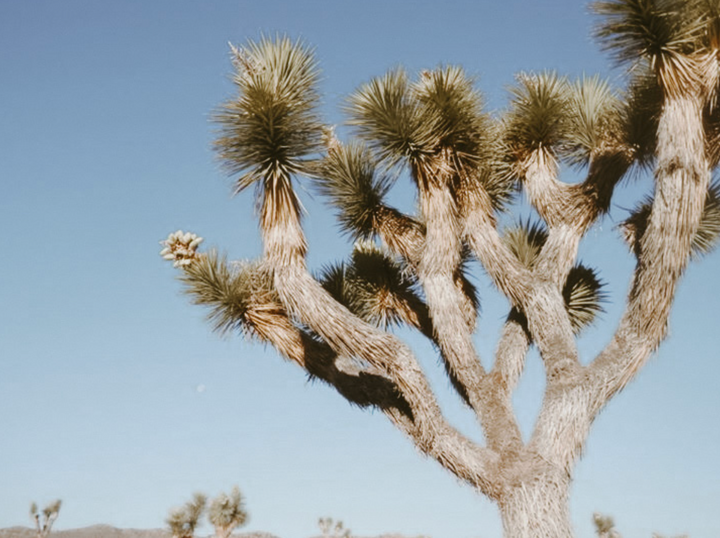
Because there aren't any. Joshua trees don't form traditional growth rings, so researchers estimate age from height, growth rate, and how much a tree has branched. Growth is slow. After an early spurt, the NPS puts it at about half an inch to 3 inches a year. The average lifespan is thought to be around 150 years, and some trees may live past 300. Heavy branching is usually a sign of an older tree.
Why do some Joshua trees have no branches at all?
They've never bloomed. Scientists believe freezing temperatures damage the growing tips, which triggers both flowers and new branches. A Joshua tree typically flowers for the first time at about 50 to 70 years old, or roughly 8 feet tall, and only when well-timed rain lines up with a crisp winter freeze. Every fork you see on a big tree marks a bloom. That's also why Joshua trees grow only where winters get cold enough to set off that cycle.
What does a moth have to do with it?
Everything. Joshua trees rely on the yucca moth for pollination. The moth collects pollen while laying her eggs inside the flower, and when the seeds develop, her larvae eat some of them. The moth gets food for her young, and the tree gets the rest of its seeds. Joshua trees can also sprout new stems from roots and branches, which helps them come back after floods or fire.
Where did the name come from?
The NPS says Mormon settlers in the mid-1800s are usually credited with the name, supposedly because the upraised branches reminded them of the biblical Joshua. The park is candid that historical records offer little evidence for the story. Long before that, the Cahuilla people called the plant hunuvat chiy'a or humwichawa, wove its tough leaves into baskets and sandals, and ate its flower buds and seeds raw or roasted.
Who lives in a Joshua tree?
Scott's orioles nest among the spiky leaves. Woodrats build homes under the armor of fallen leaves. Desert night lizards hunt insects beneath downed trunks. A fallen Joshua tree is still working, which is a good reason to leave dead wood where it lies.
How many are there, and where are the tallest?
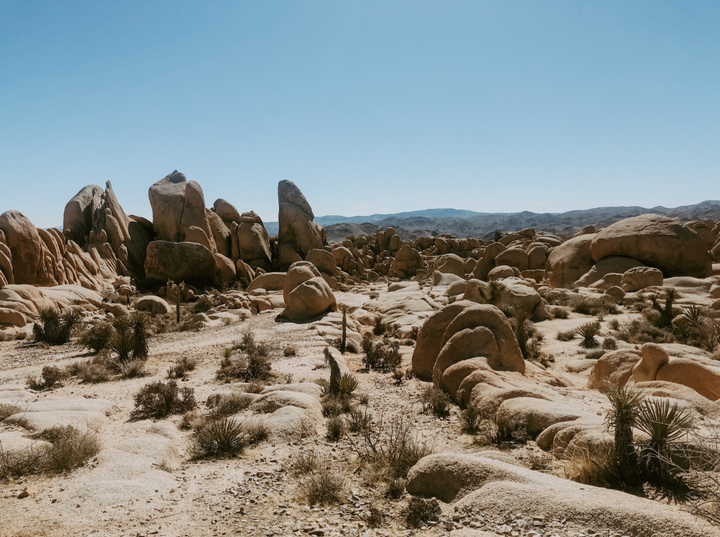
The park estimates about 870,000 Joshua trees inside its boundaries, growing between roughly 2,800 and 5,800 feet. Most top out near 40 feet, and rare giants reach 50. The NPS points to Covington Flats for some of the tallest, and Park Boulevard for the easiest drive-through views, with pullouts and trailheads along the way. Joshua trees aren't unique to the park, either. They grow across the Mojave in California, Arizona, Utah, and Nevada. As the park puts it, if you see one, you're probably in the Mojave.
How do you visit them without hurting them?
Follow Leave No Trace: stay on trails and established pullouts, since the desert's crusty soil takes decades to recover from footprints. Don't climb on or hang from Joshua trees; their branches are brittle and their roots are shallow. Leave seed pods, dead branches, and fallen trunks in place. Pack out everything you bring in.
Bring a little of the desert home
When you're back on 29 Palms Highway, stop by JT Trading Post at 61716 29 Palms Hwy in Joshua Tree, where 42+ local vendors stock desert-made goods. We're open Mon–Fri 12–5 PM and Sat–Sun 8 AM–5 PM, and everything in the shop is also at jttradingpost.com.
FAQ
Is a Joshua tree a cactus? No. It's in the agave family and is a monocot, related to grasses and orchids.
How old is the average Joshua tree? The NPS estimates an average lifespan of around 150 years, with some living over 300.
When do Joshua trees bloom? Usually mid-February through April, and only after the right rain and a winter freeze. The NPS notes an unusual bloom in 2019 began as early as Thanksgiving.
How tall do Joshua trees get? Most reach about 40 feet, and a rare few reach 50. Covington Flats has some of the park's tallest.
How many Joshua trees are in Joshua Tree National Park? About 870,000, according to park estimates.
Sources
- National Park Service, Joshua Trees, Joshua Tree National Park (last updated Aug. 27, 2025)
- Leave No Trace Center for Outdoor Ethics, The 7 Principles
Hi-Desert Field Desk is JT Trading Post's events and guides desk in Joshua Tree. We check every date, price, and closure against official sources the morning we publish.