Where Two Deserts Meet: The Spring Convergence Zone of Joshua Tree
Joshua Tree National Park sits at the convergence of the Mojave and Colorado Deserts — two distinct ecosystems that create one of California's most biodiverse landscapes. A deep look at what makes this desert meeting point unique.

On this page
Every March, something remarkable happens at Joshua Tree National Park. It's not just the wildflowers — though those are extraordinary right now. It's the collision of two entire desert worlds, playing out in real time across the landscape.
A Park Built on a Boundary
Most visitors don't realize they're standing on one of the most ecologically dramatic boundaries in North America. Joshua Tree National Park straddles the meeting point of two distinct desert ecosystems: the Mojave Desert in the park's higher northern reaches, and the Colorado Desert — a subdivision of the Sonoran Desert — in the lower southern portions.
This isn't just a cartographic curiosity. The two deserts operate on entirely different terms. The Mojave sits at higher elevations (above 3,000 feet), receives more winter precipitation, and experiences colder nights. The Colorado Desert, dropping below 3,000 feet, is hotter, drier, and defined by spindly ocotillo and the infamous jumping cholla rather than Joshua trees.
In March, both worlds are simultaneously waking up — and the contrast is stunning.
The Mojave Side: Joshua Trees and the Bloom
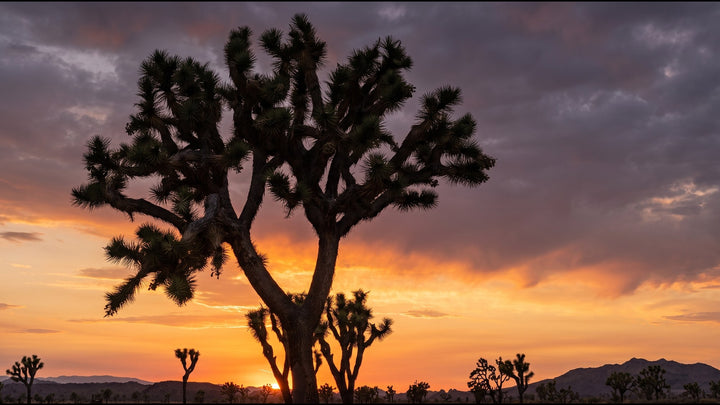
Up in the park's northern half, the Joshua trees are putting on their quiet spring display. These are not true trees at all, but giant yuccas — members of the agave family — that can live for 150 years or more. Each spike-leafed arm is the result of decades of growth following a bloom. Without the bloom, no branching occurs.
This year's wildflower season has been exceptional. Winter rains arrived on time and in generous amounts across the Mojave, setting the stage for a bloom that peaked around March 9th. The Utah Trail area has been particularly vibrant, with desert bluebells (Phacelia campanularia) and notch-leaf scorpion weed putting on a show alongside poppies, lupine, and desert lavender.
By mid-March, blooms are winding down at lower elevations, but lingering on north-facing slopes and at higher ground. If you're visiting this week, head for the pinyon-juniper transition zones above 4,500 feet for your best chances at finding flowers still on the stem.
The Colorado Side: Cholla and Ocotillo Emerge
Drop down into the park's southern section and you enter a different world. The ocotillo, which looks dead all winter — a tangle of gray thorned stalks — is beginning to leaf out with tiny green leaves, responding to recent rains. Within weeks, bright red flower clusters will cap each stem, drawing hummingbirds on their spring migration north.
The cholla cactus gardens in this zone are one of the park's most otherworldly features. Note: the main Cholla Cactus Garden Trail is currently closed for restoration work, expected to reopen late spring. The effort is worth monitoring — it's one of the few places on Earth where Bigelow cholla grows in such density that the ground literally glows golden in afternoon light.
The Inselberg Landscape: Reading the Rocks in Spring Light
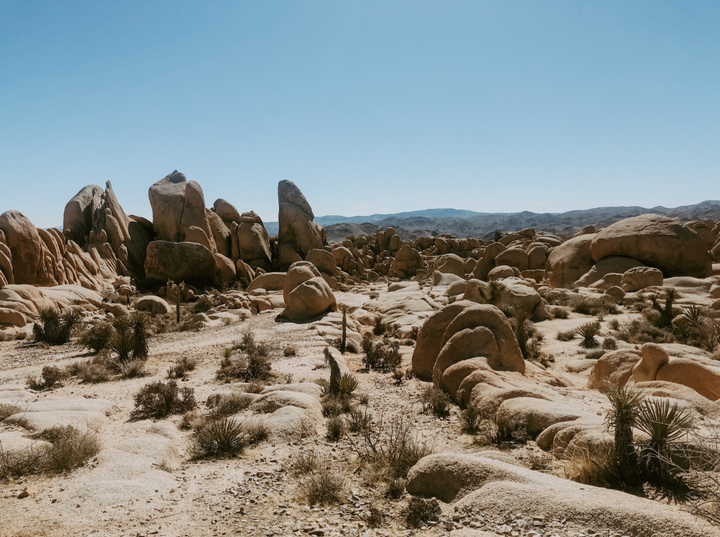
Everywhere you look, the park's signature rounded boulders rise from the desert floor. These formations are known as inselbergs — "island mountains" — and their rounded forms are no accident.
Roughly 85 million years ago, magma intruded the existing gneiss deep underground and slowly cooled into White Tank monzogranite. As it solidified, the rock developed three intersecting rectangular joint systems. Groundwater percolated through these fractures for millions of years, chemically rounding the sharp corners through a process called spheroidal weathering. When erosion eventually stripped away the overlying softer rock, these pre-rounded boulders emerged, already sculpted.
Spring morning light hits these formations at a low angle, casting dramatic shadows that reveal the texture and stratification in the rock. Geologists call it some of the most readable granite on Earth. For the rest of us, it's just spectacular.
March: The Sweet Spot
For naturalists, March is arguably the finest month in the Joshua Tree calendar. Temperatures are mild — highs in the mid-60s to low 70s, dropping to the 40s at night. Wildlife is active: ravens are nesting on boulder faces, coyotes are denning, and as a timely spring reminder, rattlesnakes are emerging from winter dormancy as soils warm. Stay on trails, watch where you step, and give any snake you encounter wide berth.
The convergence zone — that liminal boundary between two desert kingdoms — is at its most dynamic and colorful right now. Whether you're a botanist, a geologist, a birder, or simply someone who loves beautiful landscapes, this is your window.
Sources: NPS Joshua Tree (nps.gov/jotr), DesertUSA wildflower reports 2026, USGS Geology of Joshua Tree, National Parks Traveler geology features, jameskaiser.com desert wildflower guide