The Ancient History of Joshua Tree — Before the Tourists, Before the Park
Before the park gates and the Instagram crowds, this landscape was home to Indigenous peoples, gold miners, homesteaders, and visionaries. The history of Joshua Tree is older than the country — and stranger than most visitors realize.

On this page
Joshua Tree National Park is one of the most visited places in California. But before the entrance gates, before the park designation, before the Airbnbs and the Instagram photographers and the festival-season crowd — this landscape was home to people who knew it in ways most visitors never will.
The history of Joshua Tree is older than the country and stranger than most people realize.
The First People
The Cahuilla, Serrano, Chemehuevi, and Mojave peoples have lived in and around the Mojave Desert for thousands of years — long before European contact and long before the park boundary existed. They didn't just pass through. They lived here, hunted here, built communities here, and developed a sophisticated understanding of the desert that took generations to accumulate.
The Oasis of Mara in Twentynine Palms was a central gathering place — a natural spring that supported life in the middle of one of the driest landscapes in North America. The Serrano called it Mara, meaning "a place of little springs and much grass." They understood what the desert could give if you understood it.
The Petroglyphs
Scattered across the rock faces of the high desert are thousands of petroglyphs — images carved into stone by the people who lived here before written language reached this part of the world. Some are geometric, some figurative, some are symbols whose meaning has been partially lost to time.
The Integratron in Landers sits near a significant concentration of these sites. The Geology Tour Road in Joshua Tree National Park passes near areas with petroglyphs that date back thousands of years. These are not casual markings. They represent a conversation with the landscape — a record of what mattered, what was here, what was coming.
Treat them with respect when you encounter them. Don't touch, don't trace, don't add anything. They've survived this long. Help them survive longer.
The Homesteaders
The late 1800s brought a different kind of arrival — prospectors and homesteaders drawn by the Desert Land Act and the Small Tract Act, federal legislation that offered cheap land to anyone willing to live on it. The desert was brutal to most of them. Some left quickly. Some stayed, built something, and left traces that are still visible in the landscape.
Keys Ranch, accessible by guided ranger tour inside the national park, is the most complete surviving homestead in the region. Bill Keys arrived in 1910 and spent the next 60 years building a self-sufficient desert ranch — a school, a store, a workshop, an orchard. His story is one of the most compelling in the history of the American West.
The Mineral Rush
Gold and silver brought people to the Mojave in the late 1800s and early 1900s. The Lost Horse Mine, accessible via a moderate hike in Joshua Tree National Park, was one of the most productive gold mines in the region — pulling out over 5,000 ounces of gold and 16,000 ounces of silver before it closed. The ruins of the stamp mill are still there. You can walk up to them, touch the rusted machinery, and feel the weight of what it took to work this land for money.
The Desert Queen Mine, the Wall Street Mill, the Eagle Mine — the park is scattered with the ruins of extraction operations that drew thousands of people to the Mojave and then left them with nothing when the veins ran out. The desert took them back quietly.
The Artists and the Visionaries
In the 1960s something different started happening in Joshua Tree. Artists, musicians, mystics, and people who didn't fit anywhere else began showing up. The landscape had always attracted people who needed space — now it was attracting people who needed inspiration. George Van Tassel built the Integratron in Landers in 1953, convinced that the location sat on a powerful geomagnetic vortex. Whether or not you believe that, the building is extraordinary — a wood structure with no metal fasteners, perfect acoustics, and a sound bath experience that has to be felt to be understood.
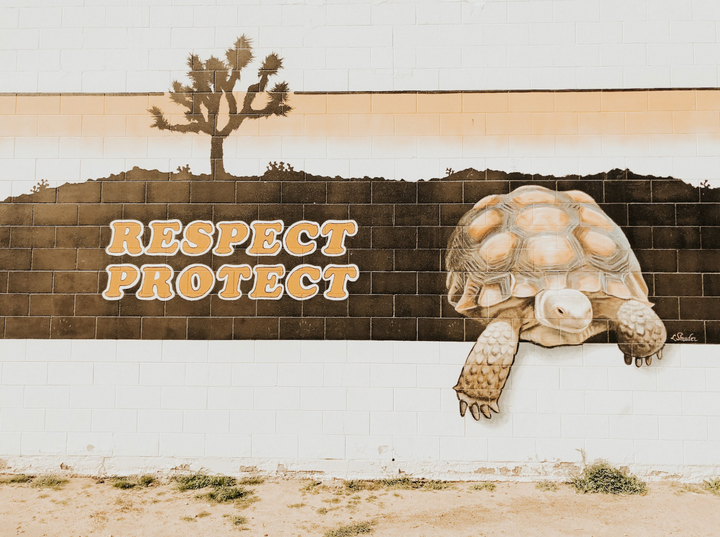
The creative community that followed over the next six decades is why Joshua Tree is what it is today — a place where the art and the landscape have become inseparable. The murals in the village, the installations scattered through the park, the music that gets made out here — all of it is downstream from the decision by a handful of people to come to the desert and stay.
JT Trading Post is part of that story. Come find us and be part of it too.