Why Mojave Creosote Bushes Smell Like Rain — and How Some Rings Live for Thousands of Years
Creosote bush resins give Mojave rain its desert scent. NPS notes clonal rings near Lucerne Valley may approach 11,700 years. Ecology and Leave No Trace.

On this page
That sharp, resinous scent after a Mojave rainstorm is mostly creosote bush, Larrea tridentata. The National Park Service says the plant’s leaves release a rich, earthy fragrance when summer rain hits the desert floor, and Organ Pipe Cactus National Monument notes that a chemical on the leaves produces a tar-like scent in high humidity—so people across the Sonoran and Mojave deserts associate that smell with rain. Some creosote clones grow outward for millennia; near Lucerne Valley, the NPS points to a ring called King Clone that radiocarbon dating and growth rates put at roughly 11,700 years old.
Updated Thursday, Nov. 5, 2026, 7:07 AM PT
Why does the desert smell like rain after a storm?
Two smells often arrive together. Classic petrichor is the earthy odor released when rain hits dry soil. The scent people mean when they say the Mojave “smells like rain,” though, is usually creosote. Joshua Tree’s creosote page describes the bush coming alive after summer rain with a fragrance that has become synonymous with the desert. The California Phenology Project, which monitors creosote inside Joshua Tree National Park, notes that the waxy, resinous leaves emit a characteristic strong odor after rainfall. At Organ Pipe, the NPS adds that on a dry day you can breathe on the leaves to mimic humidity and catch that same desert-rain note. Smell it, photograph it, and leave the plant where it is.
What is creosote bush, botanically?
Creosote is a native evergreen shrub in the caltrop family, Zygophyllaceae. Joshua Tree’s plant checklist lists it blooming April–May below about 1,000 meters (roughly 3,280 feet). USDA Forest Service Fire Effects Information System material puts it throughout the Mojave, Sonoran, and Chihuahuan deserts, from southern California into Nevada, Utah, Arizona, New Mexico, western Texas, and northern Mexico. The park says Mojave creosote often stands about six feet tall in an upside-down cone of branches from a central crown. Leaves are small, paired, dark green, and coated in resin that slows water loss. Yellow five-petaled flowers give way to fuzzy seeds; the NPS notes that germination is rare and recovery from disturbance is slow—even a plant only a foot tall may already be ten years old.
The park also explains that what looks like one species is three chromosome forms: Mojave creosote with 78 chromosomes, a Sonoran form with 52, and a Chihuahuan (West Texas) form with 26. That polyploidy may have helped Mojave plants cope with less summer rainfall. Fossil and genetic evidence, per the NPS, suggest creosote moved north from the Sonoran Desert into this part of California about 11,000 to 12,000 years ago as the climate warmed and dried and juniper retreated upslope.
How does a shrub turn into a living ring?
Slowly, and in place. After a few decades—the park cites 30 to 90 years—older branches die and the crown splits. New stem crowns keep growing outward from the edge, all genetically descended from one seed. The center eventually opens into bare ground as dead wood decays, leaving a circle of living stems. USDA FEIS summarizes the same pattern: clones expand into rings many meters across. Those rings are what visitors sometimes notice as circular mounds or arcs of green in open bajadas. They are not separate seedlings that happened to line up; they are one organism’s long outward walk.
What is King Clone?
Near Lucerne Valley, in the western Mojave, one of those rings is famous enough that the NPS names it on Joshua Tree’s creosote page: King Clone, about 45 feet across and approximately 11,700 years old by radiocarbon dating plus known growth rates. The park calls it one of the oldest living organisms on Earth. The scientific estimate traces to University of California, Riverside botanist Frank C. Vasek’s 1980 paper in the American Journal of Botany, which extrapolated an age that “may approach 11,700 years” for the largest known clone (average radius about 7.8 meters) from measured growth rates and radiocarbon-dated wood. Vasek hedged the number: if growth rates changed over time, that clone’s age may be somewhat less. Public summaries sometimes round or differ slightly, so treat ~11,700 years as an extrapolation anchored in that work and reflected on the park’s page—not a birthday carved in stone.
We are not mapping turn-by-turn directions to the ring. The NPS places it in the Lucerne Valley area; treat that as public interpretive context, stay on durable surfaces if you visit any public land nearby, and do not dig, probe, or collect wood or cuttings from wild plants.
Where does creosote fit in Mojave plant communities?
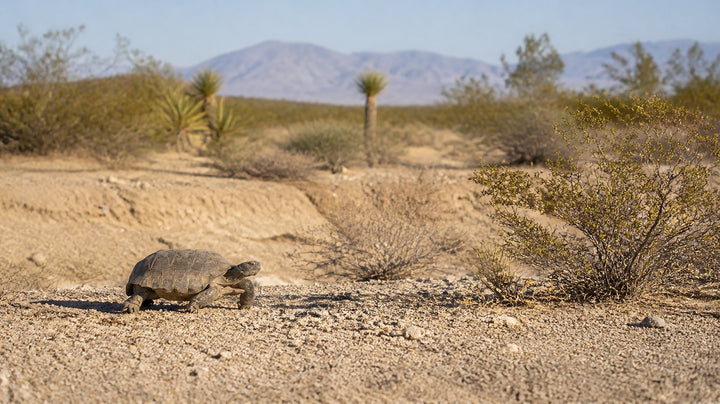
It is often the dominant shrub on lower-elevation flats and bajadas. FEIS cites the creosotebush–white bursage (Ambrosia dumosa) association as covering roughly 70 percent of the Mojave Desert. Joshua Tree’s plants overview calls creosote widespread through the park and the desert Southwest, and the park’s creosote page notes it defines much of the lower-elevation landscape. Animals use the shade and structure: lizards under the branches, insects on leaves and flowers, birds resting in the canopy. FEIS adds that desert tortoises often dig shelters under creosote where roots stabilize soil. In short, creosote is infrastructure as much as scenery.
How do you enjoy creosote without harming it?
Follow Leave No Trace. Travel and camp on durable surfaces—established trails, rock, gravel, and bare ground already in use—so cryptobiotic crusts and seedling niches can recover. Leave what you find: no cuttings, no dug roots, no souvenir seed pods from wild plants. Pack out every crumb. Creosote recovers slowly from disturbance, and the park is clear that germination success is rare.
This weekend happens to line up with Joshua Tree’s 2026 Leave No Trace Spotlight. The Subaru/Leave No Trace Traveling Team and partners list a free Desert Discovery Day on Saturday, Nov. 7, 10 AM–1 PM at Freedom Plaza Gym in Twentynine Palms—family programs with park rangers, scientists, and Leave No Trace staff; registration required. It’s on our Around town calendar. The plant itself asks for the quieter version of the same ethic every day you walk the basin: look, smell after rain, stay on durable ground.
Bring a little of the desert home
When you’re back on 29 Palms Highway, stop by JT Trading Post at 61716 29 Palms Hwy in Joshua Tree, where 42+ local vendors stock desert-made goods. We’re open Mon–Fri 12–5 PM and Sat–Sun 8 AM–5 PM, and everything in the shop is also at jttradingpost.com.
FAQ
Why does creosote smell after rain? Resinous oils on the leaves release a strong, tar-like scent when humidity rises or rain wets the foliage. The NPS at Joshua Tree and Organ Pipe both describe that odor as the desert’s rain scent.
Is the smell the same as petrichor? Not exactly. Petrichor is the soil smell of rain on dry ground. Creosote’s resin scent is from the plant; after a storm you often get both.
How old is King Clone? Joshua Tree’s NPS page lists it at approximately 11,700 years old and about 45 feet across, near Lucerne Valley. Vasek’s 1980 study extrapolated an age that may approach 11,700 years and noted the true age could be somewhat less if growth rates changed.
Can I take a cutting or dig a seedling? No. Leave wild plants where they are. Germination is rare and recovery from disturbance is slow. Buy nursery-grown natives if you want creosote at home.
Where does creosote grow in Joshua Tree? Widespread on lower-elevation ground throughout much of the park, especially the southern and lower basins, typically below about 1,000 meters per the park’s plant checklist.
Sources
- National Park Service, Creosote Bush, Joshua Tree National Park (last updated April 7, 2025)
- National Park Service, Larrea tridentata plant checklist, Joshua Tree National Park (last updated Feb. 28, 2015)
- National Park Service, Plants, Joshua Tree National Park (last updated June 3, 2025)
- National Park Service, Trees and Shrubs — Creosote bush, Organ Pipe Cactus National Monument (last updated Aug. 19, 2023)
- California Phenology Project / UC Santa Barbara, Creosote (Larrea tridentata)
- USDA Forest Service, Fire Effects Information System, Larrea tridentata (Marshall 1995; images updated 2018)
- USDA NRCS PLANTS Database, Larrea tridentata (LATR2)
- Vasek, F. C. 1980. “Creosote Bush: Long-Lived Clones in the Mojave Desert.” American Journal of Botany 67(2): 246–255 (Wiley abstract)
- Leave No Trace Center for Outdoor Ethics, The 7 Principles; Joshua Tree National Park Spotlight, Nov. 5–7, 2026; Desert Institute / JTNPA, Desert Discovery Day registration (checked the morning of Nov. 5, 2026)
Hi-Desert Field Desk is JT Trading Post's events and guides desk in Joshua Tree. We check every date, price, and closure against official sources the morning we publish.